Executive thesis
Canada’s food-manufacturing acquisition opportunity is not a single market-size statistic or a prediction that every regional plant should be consolidated. It is a screening problem. The most credible opportunities are established frozen-food, ready-to-eat, specialty and ethnic-food manufacturers whose products and customers are proven, but whose next stage is constrained by succession, management depth, documentation, distribution, capital or genuinely usable capacity.
A Canada-for-Canada strategy starts with domestic operating evidence: revenue and gross margin by product and customer, customer retention, food-safety controls, capacity by line and shift, working-capital needs, equipment condition and management continuity. Interprovincial expansion, private label, co-pack, institutional foodservice and import substitution may create value. They become transaction value only when a target can demonstrate the capacity, compliance, logistics, labour and capital to execute them.
For buyers, the question is not “How large is Canadian food?” It is “Which target can transfer safely into a platform and support the next dollar of investment?” For owners, it is “What must be documented or repaired before a buyer, lender or investor tests the business?”
The verified market context
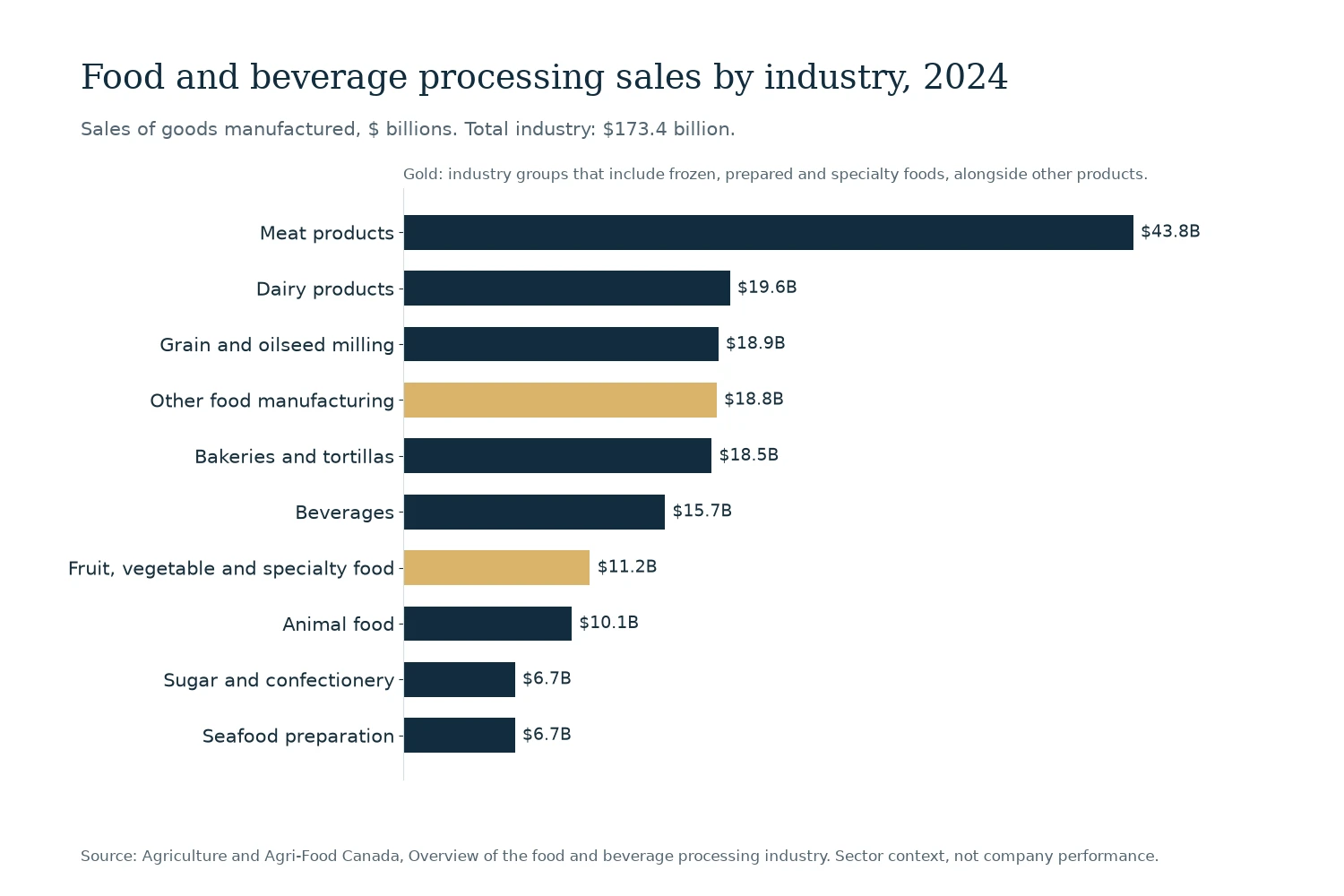
Agriculture and Agri-Food Canada reports that in 2024 Canada’s food and beverage processing industry recorded $173.4 billion in sales of goods manufactured, represented 20.3% of total manufacturing sales, generated 1.6% of national GDP, and employed 318,400 Canadians. The industry supplied approximately 80% of processed food and beverage products available in Canada. These figures establish sector scale; they do not identify an acquisition target, normalize EBITDA or prove a return. AAFC, “Overview of the food and beverage processing industry”.
Statistics Canada’s August 2026 Monthly Survey of Manufacturing reported food-manufacturing sales of $13.835 billion, seasonally adjusted, current dollars—flat from July 2026 and up 6.4% from August 2025. The same release reported total manufacturing sales of $79.9 billion. This is an industry flow measure, not the revenue of a particular frozen-food or ready-to-eat company. Statistics Canada, Monthly Survey of Manufacturing, August 2026, Table 2.
The capacity observation available at publication is for August 2026. Food-manufacturing capacity utilization was 81.3%, unadjusted, preliminary and marked “use with caution,” compared with 79.9% in July 2026 and 77.2% in August 2025. It describes an industry average; it is not evidence that a target plant has 18.7% of safe, staffed, saleable spare capacity. Statistics Canada, Table 5, August 2026.
A domestic-market thesis also needs a realistic view of reach. ISED’s SME Profile reports $532.0 billion of interprovincial trade in 2023, comprising $231.2 billion of goods and $300.8 billion of services. In the same profile, 46.7% of manufacturing SMEs reported interprovincial sales; across all SMEs, 25.3% traded interprovincially and those sales averaged 5.6% of total sales. The measures cover SMEs generally, not food manufacturers specifically, and do not mean that a target can automatically sell in every province. ISED, “SME Profile: Interprovincial trade”.
Where the opportunity tends to hide
1. Succession before distress. A founder may own the customer relationships, formula knowledge, production decisions and supplier negotiations. The company can be economically sound while being difficult to transfer. A buyer may find a good product and an incomplete institution. That gap can support a staged purchase, management transition or platform acquisition—but only after the cost of replacing the founder and documenting know-how is recognized.
2. Capability before brand. Attractive targets may have blast-freezing, prepared-protein, allergen-control, co-pack, private-label, ethnic-recipe or institutional-production capabilities that are more valuable to a platform than the brand alone. The capability must be tested for reliability, customer permissions, maintenance, labour and food-safety performance.
3. Regional products with a transferable route to market. A product that sells in one community is not automatically a national product. Buyers should test shelf life, packaging, bilingual or other labelling requirements, distributor economics, freight density, cold-chain service levels and customer acquisition costs province by province.
4. Underused assets with a demand path. A second shift, packaging line or freezer can be strategically useful. “Available hours” are not a forecast. Incremental output requires labour, ingredients, packaging, sanitation windows, QA release, working capital, customer orders and a reliable maintenance plan.
5. Fragmented functions that a platform can strengthen. Procurement, finance, HR, logistics, QA administration and sales support may be centralized after an acquisition. The savings case should be built from actual spend, role coverage and implementation cost—not a generic synergy percentage. Integration can also add complexity, customer disruption and systems risk.
ISED’s 2025 Canadian Industry Statistics provide a useful discovery map, not a deal list. For NAICS 3114, Fruit and Vegetable Preserving and Specialty Food Manufacturing, ISED reports 375 employer establishments nationally, including 140 in Ontario and 98 in Quebec. For NAICS 3119, Other Food Manufacturing, it reports 1,778 employer establishments nationally, including 598 in Ontario and 498 in Quebec. These are establishments, not unique companies; they do not disclose ownership, revenue, EBITDA, readiness or willingness to transact. ISED NAICS 3114 and NAICS 3119.
What makes a target “Canada-for-Canada” credible?
A credible target does not need to reject export markets. It needs a defensible domestic base and a clear reason that Canadian ownership, consolidation or capital can improve the business. The evidence file should answer:
• Which products and customers produce contribution after rebates, deductions, freight and trade spend?
• What percentage of sales is recurring, seasonal, project-based, private-label or co-pack?
• What are the top-customer and top-supplier concentrations, and what contracts or informal dependencies exist?
• Is the CFIA licence and preventive-control plan appropriate for the actual interprovincial activities?
• Are recalls, audit findings, quality holds, allergen controls and traceability records complete?
• What is current, peak and theoretical capacity by bottleneck, line, shift and sanitation schedule?
• Which equipment and infrastructure require replacement within 24–36 months?
• What working capital is needed for inventory, seasonality, customer terms and growth?
• Who can run the plant, quality system, commercial function and finance process after closing?
CFIA guidance confirms that most businesses manufacturing, processing, packaging or labelling food for export or shipment across provincial or territorial borders require a Safe Food for Canadians licence and preventive controls; many must maintain a written preventive control plan. A target’s licence status is therefore a transaction-readiness issue, not a marketing footnote. CFIA preventive food-safety controls.
Decision implications for buyers and owners
For buyers: build a platform thesis before target outreach. Define the product categories, geography, customer channels, operating capabilities and capital available. Underwrite existing earnings separately from uncommitted synergies, policy benefits and export upside. Treat a bolt-on as a second operating system that must be absorbed, not as a spreadsheet line.
For owners: preparation is not cosmetic. Reconcile reported results to tax returns and the general ledger, explain owner adjustments, document customer and supplier relationships, inventory aging, food-safety evidence, equipment condition and management roles. If the business is not ready, a preparation period may protect value better than premature exposure.
For lenders and investors: demand a sources-and-uses schedule that includes purchase consideration, fees, working capital, maintenance capex, growth capex and post-closing liquidity. A financing plan should survive a downside case involving customer loss, margin compression, labour cost, inventory turns and delayed improvements.
For all parties: domestic expansion is not frictionless. Product-specific labelling, licensing, provincial rules, freight, environmental obligations and procurement requirements still matter. The April 21, 2026 launch of the Domestic Trade Commissioners Network is a useful policy signal for internal trade, but it is not a customer contract or a forecast for a target. Government of Canada, April 21, 2026.
Fictional illustrative case — not an actual client result
A fictional Ontario prepared-meals manufacturer has a strong regional grocery and foodservice base, an owner nearing retirement and a packaging line that is not used on weekends. A first screen labels it a platform candidate. An Independent Review finds that the apparent spare capacity is limited by sanitation, one scarce skilled operator, freezer staging and customer-specific packaging. Two customers represent a large share of contribution, while several low-margin SKUs consume disproportionate changeover time. The decision is prepare, not “buy immediately”: validate customer retention, hire or promote an operations lead, price the weekend shift, rationalize SKUs, document the preventive-control plan and fund maintenance before approaching a lender. The example shows why industry capacity statistics cannot be substituted for target evidence.
Confidential next step
A confidential Transaction Readiness Call can test whether the acquisition, sale, succession or funding objective is sufficiently defined for an Independent Review. MerchantBanker.ca’s methodology uses a structured questionnaire, management interview and evidence review to reach a decision: proceed, prepare, restructure, defer or stop. The Independent Review is a paid, decision-oriented engagement under a signed scope; it does not automatically include a Confidential Information Memorandum (CIM). A CIM is included only when expressly specified in the signed scope, and full buyer or seller representation requires a separate signed engagement. Legal, tax, accounting, valuation, securities, food-safety and other regulated advice remains with qualified specialists.
Data notes and limitations
Data available as of November 12, 2026. Quarter labels identify this paper’s theme within MerchantBanker.ca’s 2026 four-part series; they do not represent a completed quarterly statistical report. Statistics are sector, survey or regulatory context, not company performance, valuation evidence or a forecast for an individual business. Some figures are preliminary, revised or marked “use with caution” by the source, and requirements can change. The illustrative case is fictional and is not a client result.
Source notes
Public sources listed below, read with MerchantBanker.ca’s Transaction Readiness framework. Market statistics are context only. Data available as of November 12, 2026.
- AAFC, “Overview of the food and beverage processing industry”
- Statistics Canada, Monthly Survey of Manufacturing, August 2026, Table 2
- Statistics Canada, Table 5, August 2026
- ISED, “SME Profile: Interprovincial trade”
- ISED NAICS 3114
- ISED NAICS 3119
- CFIA preventive food-safety controls
- Government of Canada, April 21, 2026
General transaction education. Company-specific decisions require appropriate financial, legal and other professional review.