Executive summary
Growth in a Canadian frozen-food, ready-to-eat or specialty-food manufacturer is not financed by revenue ambition alone. An acquisition must pay the purchase consideration, fund the operating cash cycle and leave enough resilience for inventory, labour, quality, maintenance and customer timing. Expansion capital must likewise be tied to a constraint that has been measured and a customer demand case that can be tested.
The public evidence supports a disciplined, not promotional, conclusion. Statistics Canada reported that food manufacturing revenue from goods manufactured reached $160.7 billion in 2024, up 2.2%; food manufacturing was the largest manufacturing subsector by this measure for the fifth consecutive year. That is a useful context signal, not evidence that a particular frozen or ready-to-eat company will grow or that a transaction deserves a premium. The annual survey covers the food subsector as a whole and fiscal periods ending between April 1, 2024 and March 31, 2025, not a calendar-year or niche-product cohort.
This paper sets out a practical financing sequence: establish the operating case; quantify cash needs; build sources and uses; test downside cases; then decide whether to proceed, prepare, restructure, defer or stop. It is general education, not a lending quote, valuation opinion or financing guarantee.
1. Start with the operating case, not the capital stack
A lender or investor will ask what the capital changes. A buyer should be able to answer with evidence: which products and customers contribute, what limits throughput, when cash is collected, and what investment removes the constraint. MerchantBanker.ca’s food-manufacturing guidance emphasizes margin by product, customer and channel; actual downtime and bottlenecks; food-safety evidence; and owner or key-person dependence.
Capacity is especially easy to overstate. A plant’s rated line speed is not sellable capacity if sanitation, changeovers, packaging, freezing, freezer space, dispatch or labour prevents production. Statistics Canada’s industrial capacity utilization measure is an industry-level ratio of actual output to estimated potential output. In its March 13, 2026 release, the seasonally adjusted food manufacturing rate was 79.7% in Q4 2025. The rate describes an aggregate industry and cannot be used as the spare capacity of a target plant. The company needs production records, downtime logs, yield, changeover time, maintenance history and customer orders.
2. Define the cash requirement in three layers
Acquisition consideration. Build a sources-and-uses schedule that separates purchase price from transaction costs, debt refinancing, taxes, fees and any seller-related payments. State explicitly whether the proposed price is on a cash-free/debt-free basis, what working capital is delivered at closing and how excess cash or debt is treated. Do not make a valuation multiple do the work of a cash-flow analysis.
Minimum operating liquidity. Model receivables, ingredients, packaging, work in process, finished frozen inventory, freight, payroll, utilities and supplier terms through a normal cycle and a stressed cycle. A new private-label contract may increase sales while requiring inventory to be bought and labour paid before the customer pays. The opening balance-sheet target and the post-close liquidity reserve must be explicit.
Growth and remediation capital. Separate equipment, refrigeration, packaging, automation, facility, systems and food-safety spending. Classify each item as maintenance, compliance, capacity expansion or optional improvement. For every growth investment, show the constraint addressed, timing, customer evidence, incremental costs, working-capital effect and downside if the volume arrives late. Forecast synergies and purchasing savings separately from historical earnings; they are not established cash flow until implemented and evidenced.
3. Match sources to risk
A practical structure may combine buyer equity, senior acquisition debt, a working-capital facility, subordinated capital and vendor participation. The right mix depends on cash conversion, collateral, leverage capacity, covenants, seller objectives and the capital provider’s mandate. Institutional capital raises are a distinct advisory situation; they are not a promise that capital will be available.
Senior debt is usually constrained by sustainable cash generation and downside resilience, not by the seller’s preferred price. A revolving facility may help fund receivables and inventory, but availability can change with borrowing-base eligibility, concentration, aging, advance rates and lender controls. Vendor financing or an earn-out can bridge a price or transition issue, but it does not eliminate performance risk; document security, ranking, measurement, disputes and repayment terms with counsel.
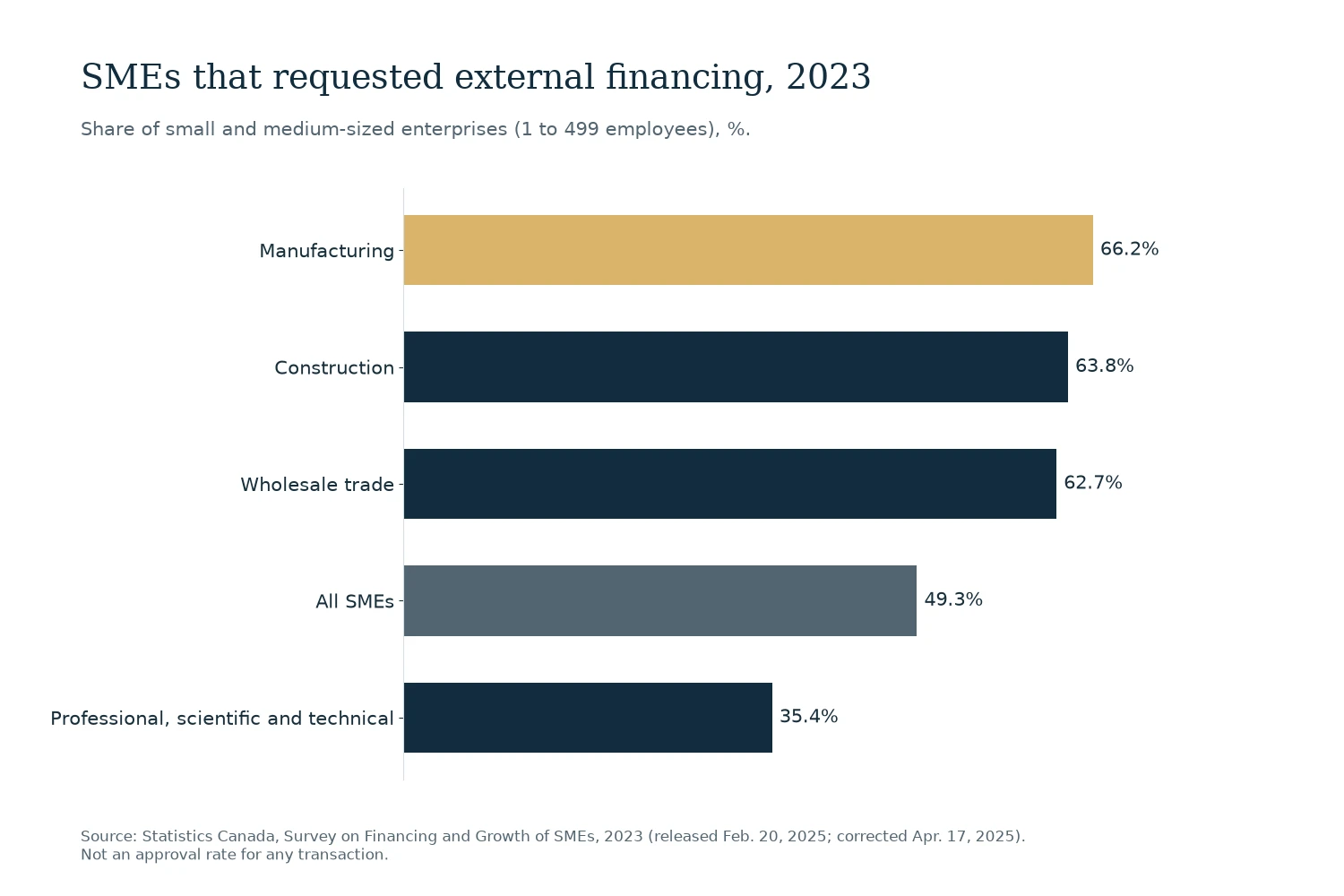
Statistics Canada’s Survey on Financing and Growth of SMEs, released February 20, 2025, found that 66.2% of manufacturing SMEs requested external financing in 2023. Across all SMEs, 25.7% requested debt financing and 88.2% had their largest debt request fully or partially approved. These are useful financing-behaviour reference points, not the probability of approval for a $3–$20 million transaction. The survey defines SMEs as businesses with 1–499 employees and at least $30,000 revenue; results came from more than 11,000 enterprises, with responses collected February–June 2024 and a correction to sector estimates posted April 17, 2025.
4. Stress-test before asking for money
Run at least a base case, a downside case and a delayed-growth case. Sensitize volume, gross margin, customer loss, collection days, inventory days, ingredient or packaging costs, labour, freight, maintenance capex, interest and covenant headroom. Include a recall, a delayed customer launch or a failed equipment installation if those risks are material. The objective is not a dramatic forecast; it is to show which assumption breaks liquidity first and who has authority to respond.
For a buyer, sources and uses should reconcile at closing and through the first twelve months. For an owner seeking expansion capital, show the use of proceeds, milestones and reporting cadence. For both, identify what is already contracted, what is management’s estimate and what is an opportunity requiring execution.
Fictional illustrative case (not a MerchantBanker.ca client result)
Assume a Canadian ready-to-eat manufacturer is considering a $4.0 million bolt-on. The target has repeat institutional and private-label customers, but its receivables average 52 days and its finished-goods inventory is seasonal. The buyer’s preliminary plan also includes $750,000 for packaging and freezer improvements and $300,000 of transaction and systems costs. These figures are assumptions for illustration only, not market benchmarks.
The first draft of sources and uses treats the $4.0 million purchase price as the whole requirement. A twelve-month cash bridge then identifies the missing items: opening working capital, a staged capex draw, integration payroll and a liquidity reserve. In the downside case, the largest customer launch is delayed by one quarter and the buyer must carry additional ingredients and packaging. The remedy is not to relabel the forecast as EBITDA; it is to reduce the initial volume assumption, phase the capex, negotiate terms, or add committed liquidity. The review may conclude that the acquisition is financeable only at a different price or structure—or that it should be deferred.
How this fits MerchantBanker.ca
Transaction Readiness is the method. The paid Independent Review is the initial decision engagement: clarify objectives, conflicts, readiness gaps and the credible next step. Its decision vocabulary is Proceed, Prepare, Restructure, Defer or Stop. The Independent Review generates financial and operational analysis. Within the signed scope, Financial Analysis can examine normalized earnings, working capital, cash conversion, debt capacity, covenant sensitivity, sources and uses and transaction scenarios; the Operational Assessment can test capacity, food safety, management depth, capex and integration risk.
A Confidential Information Memorandum (CIM) is only an expressly scoped, signed deliverable. It does not assure financing, replace lender underwriting or constitute representation. Full buy-side or sell-side advisory requires a separately signed mandate. Any institutional capital raise is separately scoped and subject to the relevant capital providers’ review. This paper makes no promise of financing, price or closing.
Next step: request a confidential Transaction Readiness discussion to assess whether an Independent Review is appropriate.
Conclusion
Acquisition capital and expansion capital become more credible when they are connected to sustainable earnings, measurable constraints, working-capital timing and a plan for downside. The strongest financing discussion is not “how much can we borrow?” It is “what is being funded, what evidence supports it, what cash is required before it pays back, and what happens if the plan is late?”
Data notes and limitations
Data available as of November 12, 2026. Quarter labels identify this paper’s theme within MerchantBanker.ca’s 2026 four-part series; they do not represent a completed quarterly statistical report. Statistics are sector, survey or regulatory context, not company performance, valuation evidence or a forecast for an individual business. Some figures are preliminary, revised or marked “use with caution” by the source, and requirements can change. The illustrative case is fictional and is not a client result.
Source notes
Public sources listed below, read with MerchantBanker.ca’s Transaction Readiness framework. Market statistics are context only. Data available as of November 12, 2026.
- Statistics Canada, Annual Survey of Manufacturing Industries, 2024 (released December 18, 2025)
- Statistics Canada, Survey on Financing and Growth of SMEs, 2023 (released February 20, 2025)
- Statistics Canada, Industrial capacity utilization rates, Table 16-10-0109-01
- CFIA, Preventive control plan requirements
- CFIA traceability
General transaction education. Company-specific decisions require appropriate financial, legal and other professional review.